Wednesday, 23 May 2012

The Dance of Zalongo

Statues marking the Dance


As Greece faces another election the results of which could well decide it's fate within the Eurozone, any parallels drawn with perilous cliff tops and fatal jumps into the unknown are apt. None is quite as pertinent to me, though, as the "dance of the Souliot women" who, in order to escape capture and enslavement by the Ottoman ruler Ali Pasha, threw themselves off the mountains of Zalongo and committed suicide en masse.

Historically, the Souliot women are seen as brave heroines who threw themselves and their children onto the rocks below rather than succumb to a nasty fate. I admire the heroism and patriotism of the act but have often wondered if perhaps they weren't a bit rash and certainly a bit unfair on the children (who presumably had no say in the matter). That brave,  almost reckless sense of 'give me freedom of give me death' that is so much a part of the Greek identity and character is now placing the country in a perilous situation with it's European partners.

Syriza leader Alexis Tsipras has captured the imagination of many Greeks with his campaign to end the 'enslavement' of the country to the international banking sector, the IMF and the EU chiefs who have called for austerity, austerity and more austerity. Voting Tsipras and his left leaning coalition into parliament would be a little bit like taking a leap into the unknown. And it could be a fatal one.

Watching Tsipras' speech before Greece's first parliamentary election was probably very much like watching the first Souliot calling on his companions to rise up against the Ottomans in 1803, a call for the 'Davids' to take arms against the 'Goliaths'.  It was a call that resonates as much with modern day Greeks as it traditionally has throughout this small country's long history, and his party gained massively in popularity. But Tsipras is a young, untried politician who has, as yet, to offer a concrete solution to Greece's problems other than a refusal to accept the (already signed) memorandum.
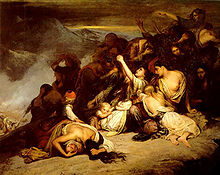
"Les Femmes Souliot" by Ari Sheffer

 Greece is now dancing the dance of Zalongo with the rest of Europe, threatening to metaphorically throw itself off the cliff if the memorandum of austerity and cuts is not revised. EU leaders were shaken by Syriza's lead in the last election and concerned that Tsipras will achieve a governmental majority this time. He just might. Angry and frustrated by a succession of inept and corrupt governments, Greeks are refusing to give their votes to the old established parties, feeling that this is the one act of defiance and democracy that is left to them by an overbearing EU. Many would rather throw themselves into the unknown than accept what they perceive as a lifetime of endless servitude and bondage to the international banks.

This song is still sung while dancing the "Dance of Zalongo":

Farewell poor world,
Farewell sweet life,
and you, my poor country,
Farewell for ever

Farewell springs,

Valleys, mountains and hills
Farewell springs
And you, women of Souli

The fish cannot live on the land

Nor the flower on the sand
And the women of Souli
Cannot live without freedom

The women of Souli

Have not only learnt how to survive
They also know how to die
Not to tolerate slavery


I am so sad to report that after writing this post the next morning the newspapers were full of this story:
Mother and son jump to their death

Wednesday, 28 March 2012

Kalazaar


It sounds like one of the biblical Magi...  Caspar, Melchior, Balthazar ....but I think that anyone who has owned a dog in this part of the world knows that this will bring no great gift. Kalazaar is a potentially fatal disease that has struck many Athenian pets in the past.

Known in medical terms as Leishmaniasis, it is transmitted by the bite of a carrier mosquito or sand fly. At first there are little or no symptoms, but left untreated this horrible disease wreaks havoc on the internal organs or skin of the unfortunate animal and leads to a painful death.

Why am I writing about this bleak subject? Well, I would like all pet owners to be aware of the latest updates in the fight against this disease.

Yesterday was time for my much loved dog, Louis, to have his biannual blood test to determine whether or not he has been exposed to Kalazaar.

Luckily, he was fine and his test was negative. While I was waiting for the results, the vet told me about a new anti Kalazaar vaccine that has just come out.  Apparently, it is expensive (€100 a shot) and has to be administered in a specific way. The first time you use the vaccine,  the animal has to receive three shots spaced out at twenty day intervals. The following year it is just one shot along with the other routine vaccinations. 

As there are obviously no long term studies done on possible side effects and long term efficacy, I'm afraid I decided to wait till next year at least before trying it out on Louis. This decision has already made me anxious and I might change my mind.  Vets say it is advisable to do the shots early on in the year as they need three months to fully take effect, so time wise the window of opportunity for this year is narrowing.  In Greece, the most dangerous months for possible Kalazaar infection are June, July, August and September so be prepared either by vaccinating, or by using products such as ©advantix plus nightly anti mosquito sprays.

A friend of mine has gone through the nightmare of dogs with Kalazaar and has chosen to vaccinate her dogs this year.  She told me it gave her peace of mind and added that, although expensive, it is nothing like the huge cost of Kalazaar treatment which can run into thousands of Euros.

♥LOUIS♥


Saturday, 24 December 2011

Merry Crisis, Happy New Fear


I would normally have posted this video on my web site, but there seems to be some Christmas gremlins obstructing that, so here it is instead!


Thursday, 13 October 2011

Erotokritos


For once I’m not writing about an Athens Living video, but one I came across on You Tube the other day.

In this video, 77 artists in 40 different locations throughout Attica take part in “Erotokritos”. This was a piece originally written by Vincenzos Kornaros in early 17th century Crete. It consists of over ten thousand fifteen-syllable rhymed verses covering themes of love, honour, friendship and courage.

This video caught my imagination for some reason, and made me want to find more about the poem and it’s author. That wasn’t easy, as not an awful lot is known about Kornaros’ life. 

Relying heavily on Wikipedia, it seems he was the son of a Venetian-Cretan aristocrat and was born near Sitia, Crete around 1553, moving later to Candia (Heraklion) around 1591. 

The island was then occupied by the Venetians and thus influenced heavily by the Italian Renaissance, having a mini renaissance of it’s own known as the Cretan Renaissance.  Domenikos Theotokopoulos (El Greco) was born in Candia during this time (painting by El Greco during his years in Crete, right), and Kornaros’ “Erotokritos” (written circa 1600 in Candia) is considered to be one of the most important pieces of Greek literature.

Inspired by an earlier French poem, Paris et Vienne, the poem has an odd mixed Hellenic and quasi Medieval setting where knights come to joust in a pre Christian ancient Athens. It tells the story Aretousa, daughter of the King of Athens and Erotokritos, son of the King's advisor.  Erotokritos disguises himself and begins to court Aretousa by singing love songs outside her window every night until she slowly falls in love with him.  Many trials and tribulations ensue but I gather there is a happy ending!

Originally written in the Cretan dialect, the verse has the type of rhyme used in traditional “mantinades” ( serenade style love songs). According to my father in law, mantinades were popular in Greek courtship until the 1950’s, and even today musicians continue to write and sing these ballads, although probably not outside their loved ones window!

So, after all this preamble, I hope you enjoy this video as much as I did. The artist’s involved are a collective who believe that the arts (primarily music) are powerful enough to inspire and unite people in a common goal. I think it’s a great idea, and I really enjoyed trying to guess the various locations throughout Attica.

Erotokritos Video


Here is another (short) video with a couple of verses about Erotokritos' despair at being exiled from his beloved Aretousa (with English subtitles).


Exile of Erotokritos


Thursday, 15 September 2011

"Marathon or Bust"

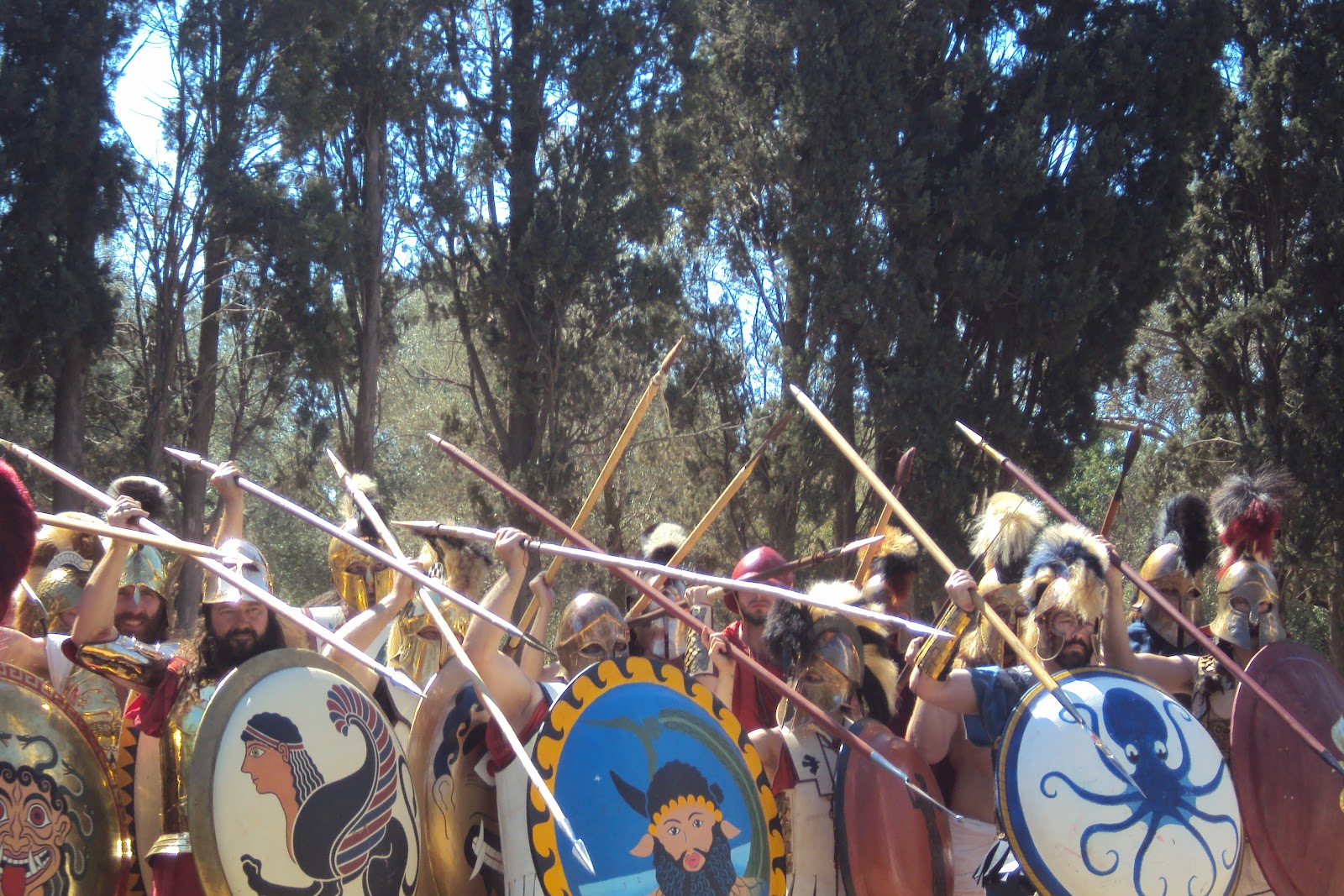
I stood for a while, looking at a white van belonging to a band of historical re enacters, keen to get to Schinias Beach to re play the final minutes of one of the most famous battles in Greece's long history- the Battle of Marathon.
On the bonnet of the van, written probably with wry humour in homage to almost every hitchiker anywhere was the sign "Marathon or Bust".  As I stared at it, I wondered if its authors knew just how apt their slogan was to modern day Greece.  Perhaps, I thought,  they don't care about Greece today and think only about its illustrious past, not its unstable present.  It would be a shame, I thought, if they don't care because that silly sign seems to sum up Greece right now so well.
Later, when I met with some of the re enacters I realised that by and large, they are a thoughtful, respectful group of people who love history (Greek history in particular) and enjoy experiencing life in ancient times through recreating it as best they can.  I got the impression that they are very aware of the financial crisis here, and do care very much how the country will fare in the coming months. They are convinced that if they are given some encouragement and support from the Greek government, their particular type of tourism will bring much needed revenue into the country in the future. Historical re enactment is an untapped source in Greece and they see boundless opportunities for future events- the Battle of Thermopylae, the Persian wars, the Athens-Sparta conflicts all bring a gleam to their eyes.
So far, the official response to all this has been nil. The event received no advertising and no help with organisation from the goverment or any official source. Only the mayor and townspeople of Marathon seemed to offer any type of assistance to the one hundred or so foreign re enacters who had travelled from as far away as Canada to take part in the three day happening. Most locals didn't even know it was taking place and the spectator turnout was poor.

Watching the re enactment of the battle,  I realised not just the sign but the whole event was a bit symbolic of the current situation. Two and a half thousand years ago and against all odds, a small army of Athenian led soldiers defeated the much larger army of the Persian Empire.  To a betting man, the odds for an Athenian win must have been dismal, and today's odds look just as gloomy for Greece.  It is engaged in an economic battle against bankruptcy that will take a Herculean, Marathon style effort to win.  Like those ancient Athenians whose chances looked pretty slim at the onset of combat,  I hope it finds the courage to face its massive problems head on and to believe that it is possible to come out victorious.
To see the video on the Battle of Marathon follow this link:
Battle of Marathon

Monday, 5 September 2011

Athens First Cemetery


Those voices are the sweeter which have fallen
forever silent, mournfully
resounding only in the heart that sorrows.

In dreams the melancholic voices come,
timorous and humble,
and bring before our feeble memory

the precious dead, whom the cold cold earth
conceals; for whom the mirthful
daybreak never shines, nor springtimes blossom.

Melodious voices sigh; and in the soul
our life’s first poetry
sounds — like music, in the night, that’s far away.  

C.P. Cavafy


It may sound odd, but I think Athens First Cemetery is one of my favourite places in the whole city. I think of it as Athens ‘secret garden’,  peaceful, green,  and full of surprising beauty.


Many Major Greek figures are buried in the First Cemetery including the country's most famous politicians, poets, artists, and heroes of the Greek Revoluton. (There are also some very well known foreigners... Lord Byron and Heinrich Schleiman both have monuments within its walls.) My father-in-law is buried there, too- another hero- not just to me, but to the country he fought so valiantly for in WWII.  Although he's never far from our thoughts, we don't go to his grave very often, but when the time rolls round for the annual "mnimosino" (memorial service) it's comforting to visit this tranquil and elegant graveyard.

One of the most famous monuments in the First Cemetery is the Sleeping Maiden. This beautiful work by Yiannoulis Halepas captures the imagination of almost everyone who sees it- chiselled for the tomb of Sofia Afenadakis, it was to be his last work before succumbing to schizophrenia shortly after completing it.  Rumour has it that he could never come to terms with the realisation that his masterpiece was imperfect- if Sofia had stretched out her legs they would have extended far beyond the couch he gave her. Personally, I think he captured an image of death as an eternal, dreamless sleep beautifully.

Anyone who has visited some of Athens oldest neighbourhoods will know that when Greeks are given enough money and a free reign, they will create amazingly quirky houses that are idiosyncratic flights of folly and a pure delight.  (If you don't know what I'm talking about, walk around Tatoi Street in Kifissia and have a look at the summer houses built around the turn of the nineteenth century)

The First cemetery is no exception, the monuments range from the bizarre to the beautiful. Many are very personal and relate directly to the deceased's family.  There are stone tributes to boy scout leaders, shipping magnates, Masons, dancers, pilots and politicians. There is even a Greek Romeo and Juliet, Michail Mimikos and German born Mary Weber who lived in Athens around 1890. The story goes that Mary threw herself of the Acropolis when she thought that her lover, Mimikos, had deserted her. He hadn't intended to, of course, and when he heard of her death he shot himself in the head. They are now buried together, under a plaque that reads "May our hearts be joined never to part again. In February departed, celestial lovers, Mimikos and Mary".

My much loved ballet teacher, Leonidas De Pian, is also buried in the first cemetery. One day, when I'm brave enough to say goodbye to him, I want to leave the last pair of pointe shoes I wore on his grave. I know this is OTT and theatrical, but it's something I feel I have to do. I was relieved to read later that people still leave half smoked cigarettes on Director Karolos Koun's grave in tribute to the Greek theatre's most notorious chain smoker, so I know I'm not alone!

Strolling along the First Cemetery's well tended pathways I feel connected to the lives commemorated here, and not seperated by the grave.  Maybe that sums up what makes the first cemetery so special... there's no feeling of lonely abandonment in this place that makes death so much a part of life.

Friday, 2 September 2011

The Sunflower's Song


September is usually the month in which farmers harvest their sunflower crops. Greece produces quite a lot of sunflower oil, and I think that anyone who has seen those magnificent fields of golden sunflowers turning black before harvest time will relate to the following poem written by my mother.           

The Sunflower's Song


The earth caressed me, and gave me force
To grow upwards and to find the source
Of light, and bursting through the warming soil,
I found the sun, and so began my life.


First my back grew tall and strong,
And green with leaves that opened up,
To help me stand and turn about
So I could move my glowing head
To follow on that fiery sun
From dawn till dusk across the sky,
So with my brothers tall and strong
We made a dazzling countryside.


And then one day I felt so frail,
My neck was weak, my head bent down,
I could not turn – Oh! Where’s the warmth?
I’m falling forwards to the ground.

I know that all my beauty’s Past,
My golden face is blacking fast,
And then we hear the awful sound,
A shuddering noise that shakes the ground,
And then I know the end is near,
But suddenly I cease to fear,
For then I know that I’m not dead
From my sad and darkened head,
Will spring to life a host of seeds

Though some be killed and turned to oil,
Some will tumble on the soil,
To flower again, a golden sight,
That turns sad darkness into light.

Prudence Chandler, 2011

Search This Blog