Thursday, 13 October 2011

Erotokritos


For once I’m not writing about an Athens Living video, but one I came across on You Tube the other day.

In this video, 77 artists in 40 different locations throughout Attica take part in “Erotokritos”. This was a piece originally written by Vincenzos Kornaros in early 17th century Crete. It consists of over ten thousand fifteen-syllable rhymed verses covering themes of love, honour, friendship and courage.

This video caught my imagination for some reason, and made me want to find more about the poem and it’s author. That wasn’t easy, as not an awful lot is known about Kornaros’ life. 

Relying heavily on Wikipedia, it seems he was the son of a Venetian-Cretan aristocrat and was born near Sitia, Crete around 1553, moving later to Candia (Heraklion) around 1591. 

The island was then occupied by the Venetians and thus influenced heavily by the Italian Renaissance, having a mini renaissance of it’s own known as the Cretan Renaissance.  Domenikos Theotokopoulos (El Greco) was born in Candia during this time (painting by El Greco during his years in Crete, right), and Kornaros’ “Erotokritos” (written circa 1600 in Candia) is considered to be one of the most important pieces of Greek literature.

Inspired by an earlier French poem, Paris et Vienne, the poem has an odd mixed Hellenic and quasi Medieval setting where knights come to joust in a pre Christian ancient Athens. It tells the story Aretousa, daughter of the King of Athens and Erotokritos, son of the King's advisor.  Erotokritos disguises himself and begins to court Aretousa by singing love songs outside her window every night until she slowly falls in love with him.  Many trials and tribulations ensue but I gather there is a happy ending!

Originally written in the Cretan dialect, the verse has the type of rhyme used in traditional “mantinades” ( serenade style love songs). According to my father in law, mantinades were popular in Greek courtship until the 1950’s, and even today musicians continue to write and sing these ballads, although probably not outside their loved ones window!

So, after all this preamble, I hope you enjoy this video as much as I did. The artist’s involved are a collective who believe that the arts (primarily music) are powerful enough to inspire and unite people in a common goal. I think it’s a great idea, and I really enjoyed trying to guess the various locations throughout Attica.

Erotokritos Video


Here is another (short) video with a couple of verses about Erotokritos' despair at being exiled from his beloved Aretousa (with English subtitles).


Exile of Erotokritos


Thursday, 15 September 2011

"Marathon or Bust"

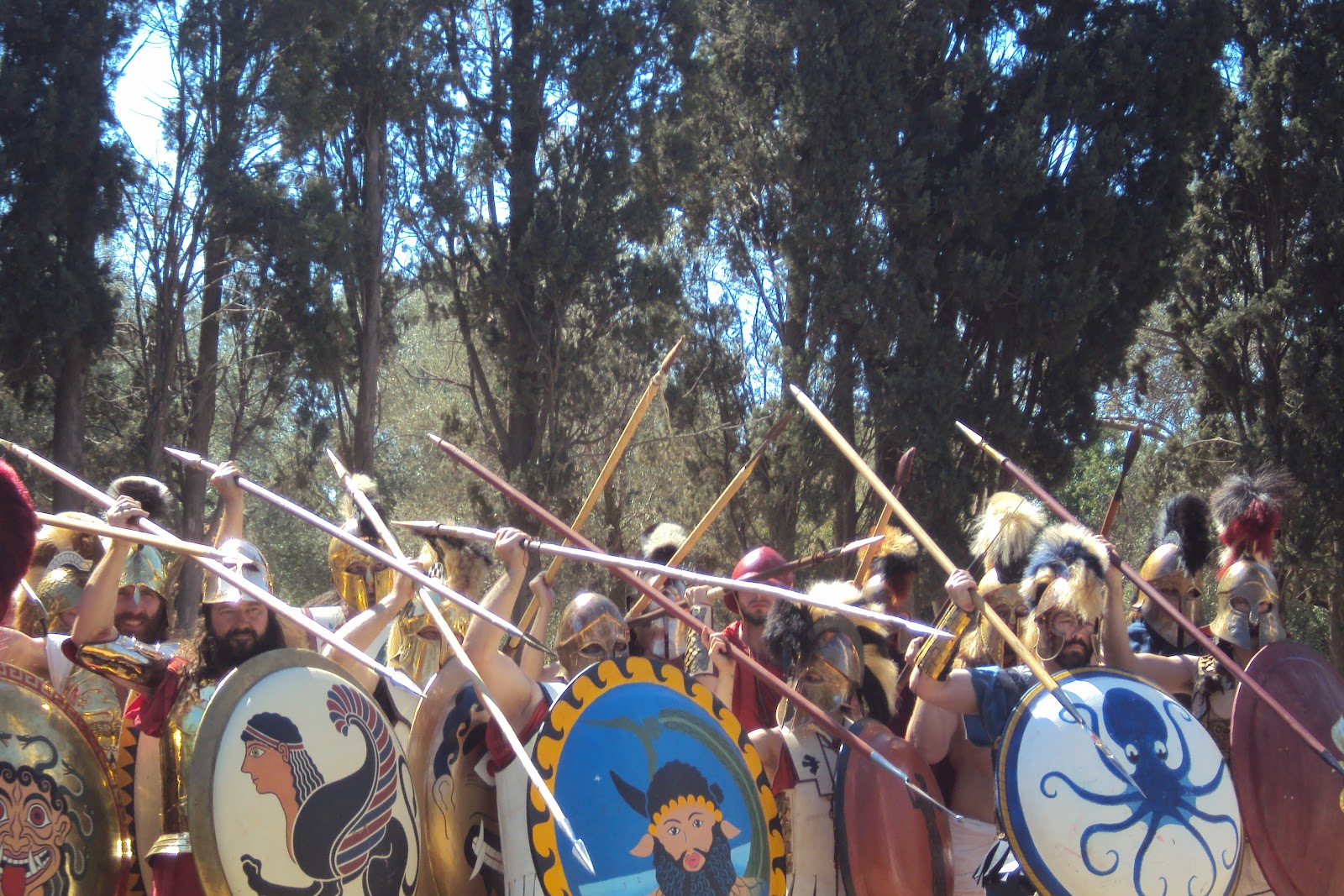
I stood for a while, looking at a white van belonging to a band of historical re enacters, keen to get to Schinias Beach to re play the final minutes of one of the most famous battles in Greece's long history- the Battle of Marathon.
On the bonnet of the van, written probably with wry humour in homage to almost every hitchiker anywhere was the sign "Marathon or Bust".  As I stared at it, I wondered if its authors knew just how apt their slogan was to modern day Greece.  Perhaps, I thought,  they don't care about Greece today and think only about its illustrious past, not its unstable present.  It would be a shame, I thought, if they don't care because that silly sign seems to sum up Greece right now so well.
Later, when I met with some of the re enacters I realised that by and large, they are a thoughtful, respectful group of people who love history (Greek history in particular) and enjoy experiencing life in ancient times through recreating it as best they can.  I got the impression that they are very aware of the financial crisis here, and do care very much how the country will fare in the coming months. They are convinced that if they are given some encouragement and support from the Greek government, their particular type of tourism will bring much needed revenue into the country in the future. Historical re enactment is an untapped source in Greece and they see boundless opportunities for future events- the Battle of Thermopylae, the Persian wars, the Athens-Sparta conflicts all bring a gleam to their eyes.
So far, the official response to all this has been nil. The event received no advertising and no help with organisation from the goverment or any official source. Only the mayor and townspeople of Marathon seemed to offer any type of assistance to the one hundred or so foreign re enacters who had travelled from as far away as Canada to take part in the three day happening. Most locals didn't even know it was taking place and the spectator turnout was poor.

Watching the re enactment of the battle,  I realised not just the sign but the whole event was a bit symbolic of the current situation. Two and a half thousand years ago and against all odds, a small army of Athenian led soldiers defeated the much larger army of the Persian Empire.  To a betting man, the odds for an Athenian win must have been dismal, and today's odds look just as gloomy for Greece.  It is engaged in an economic battle against bankruptcy that will take a Herculean, Marathon style effort to win.  Like those ancient Athenians whose chances looked pretty slim at the onset of combat,  I hope it finds the courage to face its massive problems head on and to believe that it is possible to come out victorious.
To see the video on the Battle of Marathon follow this link:
Battle of Marathon

Monday, 5 September 2011

Athens First Cemetery


Those voices are the sweeter which have fallen
forever silent, mournfully
resounding only in the heart that sorrows.

In dreams the melancholic voices come,
timorous and humble,
and bring before our feeble memory

the precious dead, whom the cold cold earth
conceals; for whom the mirthful
daybreak never shines, nor springtimes blossom.

Melodious voices sigh; and in the soul
our life’s first poetry
sounds — like music, in the night, that’s far away.  

C.P. Cavafy


It may sound odd, but I think Athens First Cemetery is one of my favourite places in the whole city. I think of it as Athens ‘secret garden’,  peaceful, green,  and full of surprising beauty.


Many Major Greek figures are buried in the First Cemetery including the country's most famous politicians, poets, artists, and heroes of the Greek Revoluton. (There are also some very well known foreigners... Lord Byron and Heinrich Schleiman both have monuments within its walls.) My father-in-law is buried there, too- another hero- not just to me, but to the country he fought so valiantly for in WWII.  Although he's never far from our thoughts, we don't go to his grave very often, but when the time rolls round for the annual "mnimosino" (memorial service) it's comforting to visit this tranquil and elegant graveyard.

One of the most famous monuments in the First Cemetery is the Sleeping Maiden. This beautiful work by Yiannoulis Halepas captures the imagination of almost everyone who sees it- chiselled for the tomb of Sofia Afenadakis, it was to be his last work before succumbing to schizophrenia shortly after completing it.  Rumour has it that he could never come to terms with the realisation that his masterpiece was imperfect- if Sofia had stretched out her legs they would have extended far beyond the couch he gave her. Personally, I think he captured an image of death as an eternal, dreamless sleep beautifully.

Anyone who has visited some of Athens oldest neighbourhoods will know that when Greeks are given enough money and a free reign, they will create amazingly quirky houses that are idiosyncratic flights of folly and a pure delight.  (If you don't know what I'm talking about, walk around Tatoi Street in Kifissia and have a look at the summer houses built around the turn of the nineteenth century)

The First cemetery is no exception, the monuments range from the bizarre to the beautiful. Many are very personal and relate directly to the deceased's family.  There are stone tributes to boy scout leaders, shipping magnates, Masons, dancers, pilots and politicians. There is even a Greek Romeo and Juliet, Michail Mimikos and German born Mary Weber who lived in Athens around 1890. The story goes that Mary threw herself of the Acropolis when she thought that her lover, Mimikos, had deserted her. He hadn't intended to, of course, and when he heard of her death he shot himself in the head. They are now buried together, under a plaque that reads "May our hearts be joined never to part again. In February departed, celestial lovers, Mimikos and Mary".

My much loved ballet teacher, Leonidas De Pian, is also buried in the first cemetery. One day, when I'm brave enough to say goodbye to him, I want to leave the last pair of pointe shoes I wore on his grave. I know this is OTT and theatrical, but it's something I feel I have to do. I was relieved to read later that people still leave half smoked cigarettes on Director Karolos Koun's grave in tribute to the Greek theatre's most notorious chain smoker, so I know I'm not alone!

Strolling along the First Cemetery's well tended pathways I feel connected to the lives commemorated here, and not seperated by the grave.  Maybe that sums up what makes the first cemetery so special... there's no feeling of lonely abandonment in this place that makes death so much a part of life.

Friday, 2 September 2011

The Sunflower's Song


September is usually the month in which farmers harvest their sunflower crops. Greece produces quite a lot of sunflower oil, and I think that anyone who has seen those magnificent fields of golden sunflowers turning black before harvest time will relate to the following poem written by my mother.           

The Sunflower's Song


The earth caressed me, and gave me force
To grow upwards and to find the source
Of light, and bursting through the warming soil,
I found the sun, and so began my life.


First my back grew tall and strong,
And green with leaves that opened up,
To help me stand and turn about
So I could move my glowing head
To follow on that fiery sun
From dawn till dusk across the sky,
So with my brothers tall and strong
We made a dazzling countryside.


And then one day I felt so frail,
My neck was weak, my head bent down,
I could not turn – Oh! Where’s the warmth?
I’m falling forwards to the ground.

I know that all my beauty’s Past,
My golden face is blacking fast,
And then we hear the awful sound,
A shuddering noise that shakes the ground,
And then I know the end is near,
But suddenly I cease to fear,
For then I know that I’m not dead
From my sad and darkened head,
Will spring to life a host of seeds

Though some be killed and turned to oil,
Some will tumble on the soil,
To flower again, a golden sight,
That turns sad darkness into light.

Prudence Chandler, 2011

Thursday, 1 September 2011

Dive! Zouberi - ATHENS LIVING VIDEOS

Dive! Zouberi - ATHENS LIVING VIDEOS


The sandy, well appointed beach at Zouberi is about 31 kilometers from the center of Athens between Nea Makri and Marathon. It’s long been one of my favourite spots for swimming as it’s not usually too crowded and the sea always seems inviting and crystal clear. It's also got some great cafés and a wonderful taverna that serves crispy 'kalamarakia' (fried squid) and a perfect Greek salad...who could ask for more?
Zouberi is quite a long beach and is kind of divided into parts by the taverna. To the left is a hotel and a few houses, and to the right are the cafés and beach bars. If you walk up to the far right end of the beach, youll come across a beachcombers hut that is the home of the Treasure Divers dive school.
Scuba diving has really taken off in Greece over the last five years as until 2006, the Greek Government attempted to protect unsalvaged undersea archaeological sites by limiting diving to a few approved areas. After a lot of underwater archaeological research, there are now only 30 areas where diving is prohibited, and luckily, Zouberi is not one of them.
Have a look at my video through the link above to find out a bit more!

Sunday, 13 February 2011

The Booze Market

                                                                                                                           
If you walk down Kolokotroni street and stroll through Booze bar into the Kourtaki Arcade you might be able to catch a “weekends only” event known as the Booze Market.

This eclectic little market is the brainchild of Marina Coriolano Lykourezos and her partner, Yiannis Yiannakos, co founders of The Crafts Factory. Marina and Yianni have joined forces with the owner of Booze bar, Nikos Louvros, to make best use of some wonderful old buildings in the centre of Athens.

Although most retailers in Athens are currently reporting low sales, since it’s first appearance over the Christmas holidays, the Booze Market has been doing pretty well. That’s not too surprising, really, as its stalls are packed with quirky, unusual items that are mostly hand made by local craftsmen, and if you are looking for a gift I don’t think there are many better places to go.

The market is open on Saturdays and Sundays and I definitely recommend you try to visit the next one. Make an afternoon of it and stop to have a drink in Booze before going home. It’s a fun and relaxing way to while away a few hours and possibly pick up a bargain or two and make some new friends!

 (Check the facebook page: The Booze Market by the Crafts Factory for dates) 


Saturday, 12 February 2011

Atenistas "Fix my City" Map

(photo from Atenistas clean-up on Phaliro beach, 2011)


Wow! What a great idea! If you are fed up with graffiti, tagging, garbage, cars parked on the pavements or painted over road signs, now you can let the Atenistas know about the problems on a street near you. Just click on the link: Atenistas Map and take it from there!

Search This Blog